
Dealer Spec Guide
Utility golf cart vs electric utility vehicle: a dealer spec guide
A buyer walks in and asks for “something to haul with.” They have a budget, a job, and two very different vehicles in front of them. We build both platforms. Below is how they differ in their published specifications, and which questions to ask before quoting.
The short version: a utility golf cart carries a fixed box; an electric utility vehicle carries a bed that tips. Cargo bed and drivetrain are separate decisions — both families are available in rear-wheel-drive and 4×4 configurations.
Buying for your own farm, hunting property or grounds operation rather than stocking a dealership? Start with four facts: what you haul, whether the load has to tip, whether the route needs 4×4, and the longest distance you cover between charges. The first four questions below answer those. The parts-shelf section after them is written for dealers.
Written by EV Cart Source, a golf cart manufacturer supplying dealers and private-label buyers. Last updated August 2026.
+ On this page(8 sections)
Question 1: Does the load have to tip? #
Start here, before price.
A four-seat utility golf cart carries a fixed box. Ours is impact-resistant polymer rated to 90 kg (200 lb) — it hoses clean, never rusts or dents. But it does not tip: the load comes out by hand, or it doesn't come out.
An electric utility vehicle carries a bed that tips. Ours is aluminum with pneumatic assist: 800 mm long × 1100 mm wide × 300 mm deep on the short-bed build, 1300 mm long × 1100 mm wide × 300 mm deep on the long bed. Payload is 300 lb (136 kg) and 500 lb (227 kg) respectively.
So: if the customer routinely unloads feed, soil, gravel, mulch or sand — loose material they would rather pour out than lift out — specify the tipping bed. If the load is mainly tools, hoses, trimmers, tarps, coolers and parts, and unloading by hand is acceptable, the fixed cargo box covers the job. Confirm payload, terrain and budget before you quote either one.
Ask it plainly: “Will you be shoveling this out, or tipping it out?”
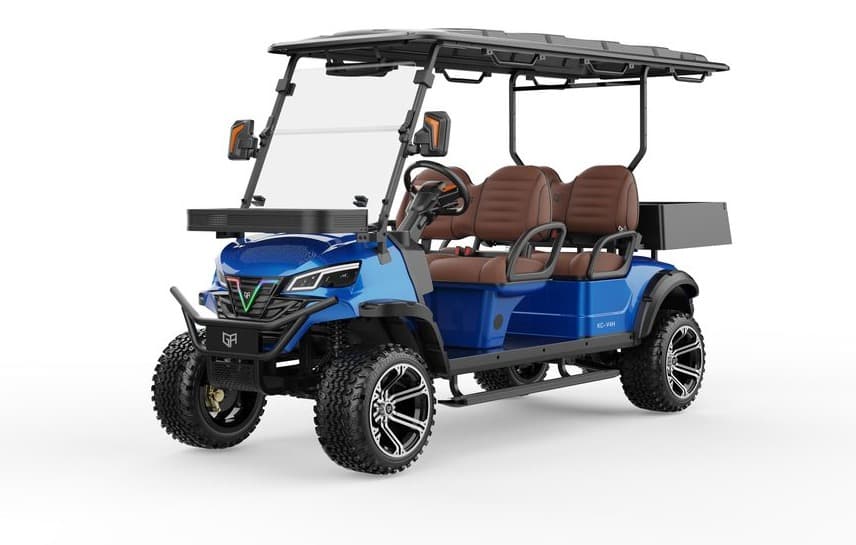
Utility golf cart — fixed impact-resistant polymer box, 90 kg (200 lb). Unloads by hand.
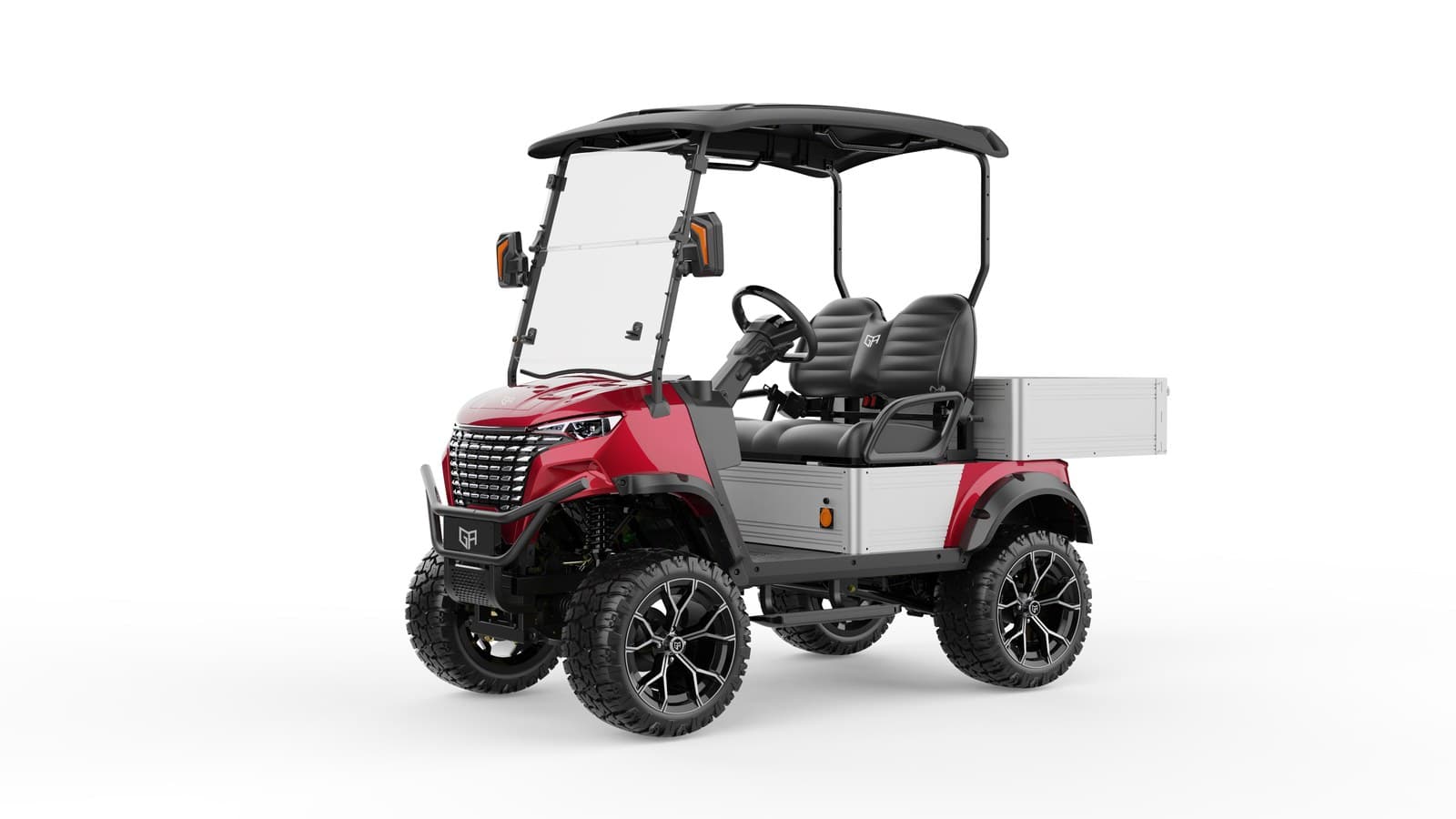
Electric utility vehicle — aluminum bed with pneumatic assist, 300 lb or 500 lb. Tips.
Question 2: Does the job need a 4x4 golf cart?
Both platforms are specified with 190 mm of minimum ground clearance and all-terrain wheels. On the utility golf cart, that is the lifted (H) chassis.
A buyer asking for an off road golf cart may mean all-terrain tires and extra clearance, or they may mean a true 4×4 that drives both axles. Ask which one before treating the two as interchangeable.
Cargo bed and drivetrain are two separate decisions. Both product families are available in rear-wheel-drive and 4×4 configurations — do not read “fixed box” as “rear-wheel drive,” or “tipping bed” as “4×4.”
In its standard configuration, the utility golf cart runs the passenger platform's 48V 5KW IP67 AC motor, driving the rear wheels; lifted builds can also be specified with part-time 4×4 and a mechanical differential lock.
The electric utility vehicle is offered as a 48V rear-wheel-drive build, or as a true 4×4 with two motors: a 72V 3KW AC induction motor on the front axle and a 72V 7.5KW permanent-magnet synchronous motor on the rear, with an electronic differential lock. The lock is the part worth explaining to a buyer: it is what keeps drive going to a wheel that still has grip when the other one is off the ground or spinning.
If the request is specifically for a 4 wheel drive golf cart, confirm whether the buyer wants the selectable mechanical system on the cart platform or the dual-motor configuration described here — the two do not share 4×4 hardware. For a hunting golf cart request, do not spec from the label: confirm the load, the unloading method, the terrain, the daily route and the site constraints first.
Rule of thumb for the sales floor: ask about surface, grade, rut depth and water exposure, then match the answer to the published drivetrain, grade and clearance figures. If the job includes water crossings or sustained side slopes, verify the application separately — the published datasheets do not provide wading-depth or sustained side-slope limits.
Both platforms climb and hold a 20% grade. Both hold on the way up and manage a controlled descent on the way down — no riding the brake pedal either way. Both run four-wheel hydraulic disc brakes with a 58 N·m electromagnetic parking brake.
Question 3: How far does it travel between charges? # #
Ask for the route length, the number of trips per shift, and whether charging is available between runs. All figures below are flat-road:
| Build | Range (flat road) |
|---|---|
| Utility golf cart (48V) | 37–50 miles (60–80 km) |
| Electric utility vehicle — 4×4, short bed | 56 miles (90 km) |
| Electric utility vehicle — 4×4, long bed | 50 miles (80 km) |
| Electric utility vehicle — RWD, short bed | 37 miles (60 km) |
| Electric utility vehicle — RWD, long bed | 31 miles (50 km) |
Two larger battery packs are available on the utility golf cart
The 37–50 mile figure above is the utility golf cart's standard pack. Two upgrades sit above it, and both fit the standard battery bay — it does not have to be enlarged, because these models share one bay size.
| LiFePO4 pack | Availability | Published flat-road range |
|---|---|---|
| 51.2V 105Ah | Standard | 37–50 miles (60–80 km) |
| 51.2V 150Ah | Upgrade | Not published — ask us for your build |
| 51.2V 230Ah | Upgrade — the largest pack the standard bay takes | Not published — ask us for your build |
We publish a range figure only for the standard pack, because that is the one every build ships with. For the two upgrades the answer moves with the configuration, and we would rather confirm it against your build than print an estimate here — tell us the build, the load and the route and we will confirm what range data we have for it. At the same charger output a larger pack takes longer to charge, so a higher-capacity pack is usually paired with a higher-output charger.
For the electric utility vehicle: it uses a 51.2V 105Ah pack in rear-wheel-drive form and a 73.6V 105Ah pack in 4×4 form. No capacity upgrade is listed for that product family, so use its published range figures above.
Note the trade buried in that table: the long bed carries 67% more (500 lb vs 300 lb) and gives up 6 miles. That suits a buyer who prioritizes payload. A vineyard or orchard crew running long rows all day on a single charge may prioritize the distance instead. Confirm the duty cycle before you quote.
Standard battery configurations are LiFePO4, documented to UN38.3 with MSDS; lead-acid is optional on applicable utility-golf-cart builds.
Question 4: Will it fit where the work is?
Turning radius is the spec buyers forget until the vehicle is on site.
| Build | Turning radius | Braking distance |
|---|---|---|
| Utility golf cart, 2- or 4-seat cargo-box build | 5 m | <4 m |
| Electric utility vehicle, short bed | 4.5 m | <3 m |
| Electric utility vehicle, long bed | 5.5 m | <4 m |
Turning radius helps determine fit through gates, barn aisles and row spacing. Trailer fit is a separate check — overall dimensions, ramp angle, deck size and weight limits. If a customer works between fixed obstacles (greenhouse rows, kennel runs, packed equipment sheds), walk the site dimensions before you quote them the long bed.
Question 5 (the one dealers ask us): what does each one do to my parts shelf? # #
This is the difference that shows up in your P&L rather than the customer's.
If you already carry our passenger G platform, the utility golf cart is the same platform you already service. Same 48V 5KW drivetrain, same four-wheel hydraulic discs, same 58 N·m electromagnetic parking brake, same lifted chassis. For an existing G-platform dealer, that adds a cargo-box SKU without adding a new drivetrain, brake or chassis service system — and it opens a buyer category (grounds crews, resorts, campuses, gated communities, farms and ranches) on parts and training you already have. If the platform is new to your shop, request the model-specific parts list before setting initial stock levels.
The electric utility vehicle's 4×4 build runs a separate 72V electrical package: front and rear motors, matched controllers, a 72V charger and its own DC-DC. Its rear-wheel-drive build runs the 48V 5KW package instead. Plan electrical spares by drivetrain, not by body style — the 72V build is a second shelf, not an extension of the first.
Either way, we recommend carrying 5–10% of order value in wear parts with the shipment.
For U.S. dealers, spare parts are stocked at our Wheatland, Missouri facility, which also handles local service and repair.
What neither of these vehicles is
Both platforms are governed to ≤25 mph. The electric utility vehicle is sold as an off-road electric utility vehicle intended for off-road, agricultural and private-property use — it is not sold as a street-legal / LSV vehicle.
The windshield, seat belts, tires and mirrors are DOT-certified components. That is a component-level certification: DOT components are not the same thing as a street-legal vehicle. Make that distinction clear before you quote, not after.
Spec'ing a first order # #
You do not have to guess the mix. Both platforms use our own private-mold body tooling and can carry your branding. For a first order:
- Start with 1 branded sample to put the vehicle in front of your customers before committing to volume
- Mix models in one container — passenger, utility-cart and utility-vehicle builds together
- Custom production runs about 45 working days after deposit and artwork approval
- 15-month vehicle warranty; 3-year lithium battery warranty; 15-month lead-acid battery warranty Wear parts are not covered
- U.S.-stocked spare parts and local service through our Wheatland, Missouri facility
Frequently asked #
- What is the difference between a utility golf cart and an electric utility vehicle?
- The cargo deck is the first difference. A utility golf cart carries a fixed impact-resistant polymer box rated to 90 kg (200 lb) — it does not tip, so the load comes out by hand. An electric utility vehicle carries an aluminum bed with pneumatic assist that tips, with a payload of 300 lb (136 kg) on the short bed and 500 lb (227 kg) on the long bed. The electrical package depends on configuration rather than on family: the utility golf cart uses the 48V 5KW passenger-platform drivetrain, and the electric utility vehicle uses a 48V 5KW system in rear-wheel-drive form or a separate 72V front-and-rear-motor system in 4×4 form. Cargo bed and drivetrain are chosen independently — both families are available in rear-wheel-drive and 4×4 configurations.
- What 4x4 golf cart systems are available, and how do their differential locks work?
- The two platforms use different 4×4 systems. On the utility golf cart, a lifted (H) chassis can be built as — or later upgraded to — a true part-time 4×4 with a hand-engaged mechanical differential lock. The 4×4 electric utility vehicle uses a dual-motor design instead: a 72V 3KW AC induction motor on the front axle and a 72V 7.5KW permanent-magnet synchronous motor on the rear, with an electronic differential lock. In both cases the lock is what keeps drive going to a wheel that still has grip when the other one is off the ground or spinning.
- How far does an electric utility vehicle go on a charge?
- On flat road: 56 miles (90 km) for the 4×4 short bed, 50 miles (80 km) for the 4×4 long bed, 37 miles (60 km) for the rear-wheel-drive short bed and 31 miles (50 km) for the rear-wheel-drive long bed. The utility golf cart has a published flat-road range of 37–50 miles (60–80 km). Use these published figures to compare builds, then confirm the route length and the number of trips per shift before quoting. Those figures are the standard packs. The utility golf cart also takes a 51.2V 150Ah or 51.2V 230Ah LiFePO4 upgrade — both fit the standard battery bay without enlarging it — but no flat-road range is published for either upgraded cargo-box build, so ask us against your specific build. The electric utility vehicle is not offered with a capacity upgrade.
- Should I order the long bed or the short bed?
- The long bed carries 67% more (500 lb versus 300 lb) and gives up 6 miles of flat-road range. Published site-fit figures are a 5.5 m turning radius and under 4 m braking distance for the long bed, against 4.5 m and under 3 m for the short bed. A buyer prioritizing payload may prefer the long bed; a crew prioritizing range, or working between fixed obstacles like greenhouse rows and kennel runs, may prefer the short bed. Walk the site dimensions before quoting the long bed.
- Are EV Cart Source electric utility vehicles street legal?
- No. EV Cart Source electric utility vehicles are sold for off-road, agricultural and private-property use, not as street-legal or LSV vehicles. Their windshield, seat belts, tires and mirrors are DOT-certified components, but that is a component-level certification — DOT components are not the same thing as a street-legal vehicle.
- Does adding a utility model mean stocking a second set of spare parts?
- It depends which one. The utility golf cart uses the same 48V 5KW drivetrain, the same four-wheel hydraulic disc brakes, the same 58 N·m electromagnetic parking brake and the same lifted chassis as the passenger platform, so for an existing G-platform dealer it adds a cargo-box SKU without adding a new drivetrain, brake or chassis service system. The 4×4 electric utility vehicle is a separate 72V electrical package — front and rear motors, matched controllers, a 72V charger and its own DC-DC — so its electrical spares need a separate stocking plan. For either platform, request the model-specific parts list before setting initial stock levels. We size common wear parts at 5–10% of order value with the shipment.
+
+
+
+
+
+
Tell us the job, and we'll tell you which platform to quote
Send the load, the unloading method, the terrain, the daily range and the site constraints, and we will recommend which configurations to quote first — including which one we would leave out. Full spec sheets and wholesale pricing come with it.