
Dealer Guide
How to become a golf cart dealer
To become a golf cart dealer, work through nine steps: confirm local demand, check whether your state requires a dealer license, decide between a franchise brand and a private-label supplier, verify that supplier's factory and certifications, plan your first container as a mixed test fleet, specify it in writing, budget spare parts at 5–10% of order value, plan assembly labor at roughly 1–3 hours per cart, and know the warranty terms before you pay a deposit.
First orders range from a single sample cart to a full container. If you can, make it a mixed container — several models and trims double as showroom stock and a live market test, and per-unit freight drops sharply at container volume. Startup cost is driven less by the carts than by freight, duty, spare parts and the working capital to hold stock while it sells.
Written by EV Cart Source, a factory-direct golf cart supplier: every model is built on our own private mold, every unit is road-tested and inspected before packing, and spare parts and after-sales support run from Wheatland, Missouri. Last updated September 2026.
Already selling carts and just comparing suppliers? Skip the guide and become a golf cart dealer under your own brand →
How to become a golf cart dealer: the 9 steps
- 1
Confirm there's demand where you are
Golf carts sell locally. List every dealer and rental operation within driving distance of your customers, note what they stock, what they charge and what's missing — then ask twenty likely buyers what they'd actually pay for. Treat a gap as a hypothesis until someone puts money down. Trade shows can help you compare suppliers and channels, but they do not prove household demand — the 2026–2027 golf cart expo calendar sorts them by which job each room actually serves.
- 2
Check licensing and where the carts will be driven
Some states require a dealer license to sell; some counties have zoning rules for a lot. Course, community and private-property use is regulated very differently from road use. Confirm both with your state vehicle authority before you specify anything. What 9 state codes actually say → Street-legal and LSV builds explained →
- 3
Choose a franchise brand or your own label
Franchise programs give you a known name and take a cut, a territory agreement and often a stocking commitment. Private label costs less to enter and lets you set your own margin, but the brand equity is yours to build. See the full comparison →
- 4
Verify the supplier is a real factory
Ask who signs off an engineering change, who approves a warranty claim, and for an unscripted video walk of the line. Check certifications at component level, not whole-vehicle marketing claims. Six checks for vetting a Chinese manufacturer → · Watch our six production stages → · What our certifications cover →
- 5
Plan your first container as a mixed test fleet
A cart shipped on its own is the most expensive freight per unit you'll ever pay, so the container is where the economics actually start. Mix it deliberately: your volume 4- and 6-seat configurations in more than one trim and color, plus one or two differentiator models — the same shipment stocks your showroom and tests the market. Want to verify build quality first? A single sample unit is available; treat it as a quality check, not a pilot business.
- 6
Specify your first order in writing
Approve a rendering of your exact configuration, plus a signed spec sheet with every option coded and a no-substitution clause. Color named in an email is not color. How private-label specification works →
- 7
Budget spare parts before the container ships
Stock common wear parts worth roughly 5–10% of order value in the same container. Your first service call decides your local reputation, and a part that has to cross an ocean costs more than it's worth. No service bay yet? Line up a local mechanic before your first sale — customers buy from whoever can fix it. Parts and service support →
- 8
Plan who bolts them together
Carts arrive SKD — bolt-on only, no cutting, no welding. One experienced technician can finish a cart on their own in about 1–3 hours; the first one always takes longer, and a second pair of hands makes it quicker. You are not on your own with it either: every order includes the illustrated installation manual — 36 sections, every step specced to the exact fastener — and when something isn't obvious, our team walks your technician through it on a video call. Budget this as shop hours, not as a training project. How assembly and service support works →
- 9
Know the warranty terms before you order
Get the warranty terms in writing before you pay a deposit — on a golf cart, the two that matter most are the vehicle warranty and the battery warranty. Ours run from factory ship date: 15 months on the vehicle, 3 years on the lithium battery. On a first order, use milestone payments and an independent pre-shipment inspection. Our ordering process →
Do you need a dealer license? Start with how your state defines “motor vehicle”
Dealer-licensing laws do not define “motor vehicle” by what the thing looks like, or by how fast it goes. They define it in a sentence near the top of the statute, and that sentence is where your answer starts. Across the 9 states below that sentence is not written the same way twice.
5 states connect that sentence — or the licensing trigger itself — to registration or title. Georgia reads “self-propelled and required to be registered under the laws of this state.” Wisconsin: “any motor-driven vehicle required to be registered under ch. 341.” Florida: “of the type and kind required to be registered and titled.” South Carolina: “any motor driven vehicle required to be registered pursuant to Section 56-3-110.” Michigan gets there through the trigger rather than the definition, counting “5 or more vehicles of a type required to be titled under this act.”
The other 4 start somewhere else, and not in the same place as each other. Texas: “‘Motor vehicle’ means a vehicle that is self-propelled.” Arizona: “an automobile, motor bus, motorcycle, truck or truck tractor or any other self-propelled vehicle, trailer or semitrailer.” Illinois reaches “vehicles,” and a vehicle is “every device, in, upon or by which any person or property is or may be transported or drawn upon a highway or requiring a certificate of title under Section 3-101(d) of this Code” — highway use or a title requirement, either one will do. Ohio does not tie the definition to registration either, but it names golf carts and takes them out.
None of those sentences is a complete licensing test. Arizona introduces title or registration later: its 7-vehicle threshold applies to a usedmotor vehicle dealer, and a “used motor vehicle” is defined as one placed in bona fide consumer use — spelled out as a vehicle “for which a certificate of title has been issued or that has been registered as provided by law.” Illinois raises it twice: the alternative title branch above, plus a “used motor vehicle” definition requiring an owner “who has been granted a Certificate of Title on such motor vehicle and has registered such motor vehicle.” One caution on that second one — the threshold section counts “used vehicles,” while the definition is of a “used motor vehicle.” We have not established how those 2 provisions apply to a non-street-legal golf cart, and we are not going to assume it. Read each state's chain to the end before you rely on where it starts.
Texas: the exemption most people assume they are standing in
Texas law forbids registering a golf cart for highway operation: “The Texas Department of Motor Vehicles may not register a golf cart for operation on a highway regardless of whether any alteration has been made to the golf cart.” It issues a golf cart license plate under a separate procedure — a plate, expressly not a registration.
Now look at the exemption everyone quotes. It excuses a person who sells “fewer than five vehicles of the same type that are owned and registered in that person's name.” That is a registration condition, sitting in the one place people treat as a safe harbor, attached to a vehicle Texas will not register for road use.
The same section separately provides that a person is not engaging in business as a dealer by selling “a vehicle the person acquired for personal or business use” — but read that one's conditions before you plan around it: the sale must not be made to avoid a requirement of the chapter, and unless it goes through a licensed auctioneer it has to be to someone other than a retail buyer. That is not a route for retailing imported inventory.
What all of this means is narrower than a rule of thumb, and still worth knowing: do not assume that staying under 5 puts you inside that exemption. The condition attached to it is one a golf cart may not be able to meet, and we found no published TxDMV guidance on how it handles that.
One state has actually answered this
Ohio's BMV publishes a form for titling all-purpose vehicles, mini-trucks, utility vehicles and under-speed vehicles — and “under-speed vehicle” is Ohio's term for, in its own words, “a vehicle (including what is commonly known as a golf cart), which has three or four wheels, an attainable speed of not more than 20 mph, and a gross vehicle weight of less than 3,000 pounds.” The statutory test is attainable speed on a paved level surface, and gross vehicle weight rating rather than what the cart happens to be carrying.
“Do I need an Ohio dealer permit number to sell a new AT, UV, US, or MT?”
“For an initial sale of an AT, the transaction must have originated from a licensed motor vehicle dealer under Ohio's dealer licensing law (R.C.) 4517.01. For an initial sale of a UV, US or MT the transaction does not have to originate from a licensed motor vehicle dealer.”
Read it for what it says. It addresses whether an initial sale of a newvehicle has to originate from a licensed dealer, and Ohio draws the line between all-purpose vehicles on one side and under-speed vehicles — golf carts — on the other. The same page states the other side of that line: a seller “may also be investigated for selling a motor vehicle without a license when law requires the vehicle to be sold by a licensed dealer.”
It also tracks Ohio's statute rather than sitting on top of it. Ohio's code says “motor vehicle … does not include … under-speed vehicles,” and the one route that might bring a cart back in — the dealer chapter also reaches “all-purpose vehicles” — runs into 2 separate exclusions in that term's own definition. It excludes “any vehicle principally used in playing golf,” and it separately excludes “any vehicle excepted from definition as a motor vehicle by division (B) of section 4501.01” — which is exactly where under-speed vehicles are excepted by name. For a cart bought to commute rather than to play golf, the second exclusion is the one doing the work.
That is the only published answer we found in all 9 states. It is Ohio's, it is written about Ohio, it is about an initial sale of a new vehicle, and it says nothing about the other 8. Two limits stay attached to it: the exclusion is drawn on wheel count, speed and weight, not on what the vehicle is called — a cart that exceeds 20 mph is not an under-speed vehicle at all — and the same form says under-speed vehicles are “titled for ownership purposes only and required for registration purposes on roads of 35 mph or less.”
We did not find an answer from the other 8 states
That is a statement about our search, not proof that nothing exists. We read the statutes, the agency FAQs, and the dealer manuals themselves. Texas's dealer manual does not contain the word “golf” anywhere, and neither does the whole of Chapter 503, the chapter that requires the license. South Carolina's dealer manual contains neither “golf” nor “low speed.”
So read what follows as what each state's own law says — not as an answer about your business.
How many carts can you sell before you need a dealer license?
Wrong question, and the way it is usually answered is what gets people in trouble. These numbers are not one kind of rule. Some are a ceiling on a private-sale escape hatch. Some are a presumption that you are already in business. They are not interchangeable, and the difference decides whether a number protects you or convicts you.
The 2 tables below are not interchangeable either. The numbers are written about “motor vehicles.” Low-speed vehicles are squarely inside that term in every one of these states — they must be titled and registered, and several states say in the statute that selling them requires a dealer license. Whether a non-street-legal golf cart is inside that term is the open question above. So the numbers go in the first table, and the second table carries no numbers at all. No number in the second table does not mean no limit — it means the prior question has to be answered first.
Low-speed vehicles and NEVs: the thresholds
Use this table if you are selling LSVs, or neighborhood electric vehicles, which is what Texas and Arizona call them.
| State | Agency | The number | What the number actually governs |
|---|---|---|---|
| Florida | FLHSMV | 3 or more in any 12 months | A rebuttable presumption that you are “engaged in such business,” § 320.27(1)(c). It reaches anyone who “buys, sells, or deals in” that many — not only your own vehicles. Florida’s separate own-use exclusion carries no number at all. |
| Texas | TxDMV | Fewer than 5 of the same type in a calendar year | An exemption, and only for vehicles owned and registered in your name. A separate provision covers vehicles acquired for personal or business use, on its own conditions. |
| South Carolina | SCDMV | More than 5 in a calendar year | Applies only to disposing of vehicles acquired for your own use. The baseline definition is anyone who “sells or attempts to effect the sale of any motor vehicle.” |
| Arizona | ADOT MVD | 7 or more used in a continuous 12 months | Sits inside the definition of used motor vehicle dealer — the verbs include “buys,” so acquisitions count, and “used motor vehicle” is itself defined to require a title issued or a registration. New-vehicle dealers have no number. |
| Georgia | SOS Board (used vehicles) | 5 or more used in one calendar year | Prima-facie evidence of being in the business, § 43-47-2(17)(A). The test is intent to profit, and it applies “whether or not such motor vehicles are owned by such person” — this is not an own-use allowance. |
| Michigan | MI Dept. of State | 5 or more of a type required to be titled, in a 12-month period | A hard rule, § 257.248(5) — and it counts buying, brokering and leasing, not only selling. |
| Illinois | IL Secretary of State | Used: 5 or more during the year. New: no number | Hard rules both ways. 5-102 carries the number; 5-101, covering new vehicles, carries none. |
| Ohio | Ohio BMV | No number for the business itself; separately, more than 5 casual sales | The 12 months run from the day of your first such sale, not a calendar year — and a “casual sale” means retail to a consumer. |
| Wisconsin | WisDOT + DFI | Up to 5 a year, only if titled to you and used personally | WisDOT, in the next sentence: “if you acquire just one vehicle with the intention of selling it, you must be licensed.” |
Sort the rows before you use them. They are 4 different mechanisms, not one. Florida's 3 and Georgia's 5 are presumptions that you are already in business, and both reach vehicles you never owned. Arizona's 7 and Michigan's 5 attach a number to specified dealing activities, and both count purchases as well as sales. Illinois's 5 sits on a business entry too — its used-vehicle section reaches a person who engages “in the business of selling or dealing in” that many. Ohio's is different in kind: alongside its business-licensing requirement, Ohio separately requires a dealer licence for more than 5 casual sales within the 12 months that start with your first such sale, subject to the exceptions that section states. “Casual sale” is itself a defined term, and the definition excludes transfers by several categories of licensee, not dealers alone — read § 4517.01 before assuming a sale of yours counts as one. Ohio's own code says that making a casual sale “is not engaging in business,” so that rule stands beside the business test rather than defining it. Texas's, South Carolina's and Wisconsin's are conditioned instead on the vehicles having been yours — titled to you, registered to you, or used by you; Wisconsin's is agency guidance rather than a statutory count.
Put plainly: a dealer importing LSVs to resell can read almost every row in that table as permission they do not have.
Non-street-legal golf carts: the prior question, state by state
| State | The definition your license turns on | Tied to registration or title? | Where that leaves it |
|---|---|---|---|
| Florida | “of the type and kind required to be registered and titled” | Yes | The test is a vehicle-type test, so it turns on what class the cart falls in, not on what it is marketed as. FLHSMV states golf carts may not be titled or registered. We found no published guidance on what that means for dealer licensing. |
| Texas | “a vehicle that is self-propelled” | Not in that sentence | Texas calls a golf cart a motor vehicle in the road-use subchapter, and the “fewer than 5” exemption carries a registration condition. We found no published TxDMV guidance on either point. |
| South Carolina | “required to be registered pursuant to Section 56-3-110” | Yes | § 56-2-90 gives carts a permit decal and a registration certificate under a different chapter, and the § 56-3-120 exemption list does not name golf carts. We found no published source resolving how the two relate. |
| Arizona | “any other self-propelled vehicle” — but see the used-vehicle definition | Not in that sentence; yes further down | Arizona defines a golf cart as a motor vehicle, with weight, speed and seating limits. But the used-dealer threshold counts “used motor vehicles,” which requires a title issued or a registration. Both sentences have to be read together, and we found no ADOT publication that does. |
| Georgia | “self-propelled and required to be registered under the laws of this state” | Yes | 2 Georgia publications need reconciling. Revenue lists “motorized carts” among vehicles the state “does not register or title.” Public Safety’s chart says, in its PTV column, that registration is “not required if electric but are required if gas.” Whether those describe the same class of vehicle is not stated by either agency. |
| Michigan | counts vehicles “of a type required to be titled under this act” | Yes | The Vehicle Code subjects every self-propelled vehicle driven on a street to the titling provisions, with no golf-cart exception in its list. The Secretary of State separately says “golf carts can’t be registered as on-road vehicles” — a statement about on-road registration, which is not the same question. Neither source addresses the dealer count. |
| Illinois | the dealer sections reach “vehicles,” defined by highway transport or a title requirement | In the alternative, and again in a later definition | Illinois calls a golf cart a motor vehicle. Its “used motor vehicle” definition separately requires an owner granted a Certificate of Title who “has registered such motor vehicle” — though the threshold section counts “used vehicles,” and we have not established how the 2 fit together for a cart. Separately: if the new-vehicle section reaches the carts you sell, it carries no numeric threshold, so the used-vehicle number is not a fallback. |
| Ohio | “does not include … under-speed vehicles” | No — excluded by name | The one state we found a published answer from. BMV, on the initial sale of a new under-speed vehicle: “the transaction does not have to originate from a licensed motor vehicle dealer.” The category is conditional on 3 or 4 wheels, ≤20 mph and under 3,000 lb GVWR. |
| Wisconsin | “required to be registered under ch. 341” | Yes | Ch. 341 attaches the duty to operating on a highway, so a cart never operated on one does not trigger the general rule; § 341.05(24) separately exempts a golf cart “being operated in accordance with s. 349.18 (1) (b) or (c) or (1m).” Neither point is an agency ruling on dealer licensing. |
The honest summary: which sentence a state starts with changes the answer. 5 of the 9 point to registration or title in that opening sentence. Texas and Arizona do not. Illinois asks in the alternative — highway use or a title requirement. Ohio takes golf carts out by name. Arizona raises title or registration only further down, in its used-vehicle definition; Illinois raises it in both places. And Ohio is the only one of the 9 we found a published answer from. For the other 8, nothing we found supports a clean yes or no — and we are not going to supply one we cannot source.
South Carolina is the clearest illustration of how a real number gets misread, because the agency saw the misreading coming. Its dealer manual carries a footnote saying that the 5-vehicles-a-year reference “only comes into play for persons disposing of motor vehicles acquired for their own use.” The number is real. It has nothing to do with a dealership.
Georgia's “5 cars a year” is real too, and misread in the opposite direction. The number is in the statute — 5 or more used vehicles in a calendar year is prima-facie evidence that you are in the business. But the definition it sits inside turns on intent to profit, and explicitly reaches vehicles you do not own. Georgia's licensing board has publicly rejected reading the figure as a licence-free quota. If you have been treating it as “my first 5 are free,” that is the reading to drop.
Illinois's own website and its own statute do not line up. The Secretary of State's dealer page says “5 or more vehicles during the year.” That matches 5-102, which covers used vehicles. The new-vehicle section, 625 ILCS 5/5-101, carries no numeric threshold. We are not going to tell you which one governs your situation — that is exactly the call to put to the Secretary of State's dealer licensing section before you import anything.
So do you need a dealer license or not?
If you are selling low-speed vehicles — or neighborhood electric vehicles, which is what Texas and Arizona call them — assume you need a dealer licence and budget for it. The first table is the one that applies to you.
If you are selling carts that never touch a road, there is exactly 1 state in this group we found a published answer from, and it is Ohio — for an initial sale of a new vehicle. For the other 8 we are not going to answer it for you, in either direction: the states do not use the same test, and 2 of them reach title or registration through a definition further down the chain — Arizona for the first time, Illinois for the second.
Ask your state's motor vehicle department two questions before you order: does the category of vehicle I intend to sell require a dealer license, and what does the buyer need to register it? Get the answers in writing. No manufacturer — including us — can answer this for your address, and you should be wary of any supplier who says they can.
State law and agency publications as read on 2026-09-20. Local authorities in these states act within powers the state grants them — they can authorize, prohibit or condition road use where the statute lets them, which is narrower than overriding state law, and narrower still than changing anything about licensing. Georgia statutory text is quoted as reproduced by Georgia DPS and the Georgia Secretary of State. This is a reading of public sources, not legal advice.
Franchise brand or your own label?
Most people researching how to become a golf cart dealer start by looking at Club Car, Yamaha or E-Z-GO dealer programs — or at newer names like ICON, Evolution and Denago. Those are all real options. They typically require territory approval, display space, a credit line and a stocking commitment, along with volume terms — none of which any of them publishes, so the specifics are settled in the course of dealing with the brand rather than read off a web page (what each one does and does not put in public is set out further down). And they put the factory's brand on your floor, alongside every competitor stocking the same platform.
The alternative is a private-label line: lower to enter, your brand rather than theirs, and priced on what your configuration is worth rather than against the identical cart at the shop down the road. It's worth noticing that the fastest-growing newer brands are themselves built on imported manufacturing — the same route a private-label dealer takes directly. The trade-off is that you build the brand equity yourself, and everything depends on the supplier you picked in step 4.
Neither is automatically right. A dealer with an existing service business and a strong local name usually does better with their own label; someone who wants a turnkey system may prefer a franchise. See the full comparison and what private-label includes →
How to become a Club Car, E-Z-GO or Yamaha dealer
Worth saying plainly, because it is the first thing people run into: none of the three publishes what it takes.Club Car's dealer page explains how agreements are structured — commercial or consumer, then split by utility vehicles, personal transportation vehicles and low-speed vehicles, with service-only arrangements also available — but states no stocking minimum, no showroom size, no credit line and no territory rule. E-Z-GO and Yamaha both route you to an enquiry form. In every case the terms are settled in the course of dealing with the brand rather than published on its website.
That makes the call the part worth preparing for. The questions that change the economics, and that are hard to renegotiate later:
- Is the territory exclusive, how is it drawn, and under what conditions can it be redrawn or reassigned?
- What is the annual volume or stocking commitment, and what happens in a year you miss it?
- What is required of the premises — showroom, service bay, technician certification — and who pays for it?
- Is floor-plan financing offered or expected, and does the agreement require a credit line?
- Can you also sell other brands, or is the line exclusive on your side too?
None of that is a mark against them. An established brand brings recognition you would spend years building, a parts network, and a customer who already trusts the name on the cowl. What you give up is that the name is theirs: the dealer three towns over can stock the same platform, and the comparison a buyer makes between you comes down to price.
The private-label route inverts that trade. You carry the brand risk, and in exchange the vehicle is only available from you. Practically, it starts smaller than a franchise does — one branded sample rather than a stocking commitment, about 45 working days from deposit and artwork approval, 15 months of vehicle warranty and 3 years on the lithium pack. Which of the two fits depends on whether you already have the local name and the service capability, or want to buy into someone else's.
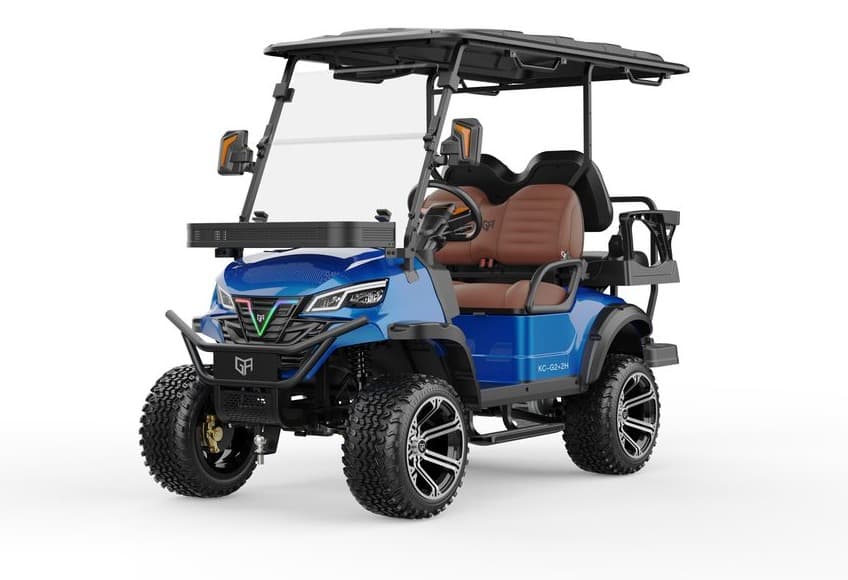
What kind of golf cart business: new carts, used carts, or both?
Used carts can cost less to acquire, but compare the full cost — purchase, inspection and repair — before assuming they are the cheaper way onto a lot, and decide in advance whether you will accept trade-ins. On an electric cart, check the battery's condition, service history and replacement cost: appearance alone does not tell you how much life is left. Inspect each used cart, price in the repairs you find, and put in writing what, if anything, you cover.
New carts cost more per unit. When you compare new-cart suppliers, get the written warranty, the exact configuration and the parts-ordering terms, and confirm replacement-part availability for the specific model. Carrying both new and used is an option if your budget and service capacity support both. If you start with only one, start with the one your service setup can support.
How much does it cost to start a golf cart dealership?
The unit price is the number people fixate on and rarely the one that decides whether year one works. Budget for all of these:
- Inventory — a mixed first container sized to your market; a sample unit first if you want to verify build quality
- Freight and marine insurance
- Duty and any additional tariffs on the country of origin — have a customs broker price this in writing before you order, because it can move the whole business case
- Customs brokerage, port charges and drayage to your yard
- Spare parts at 5–10% of order value on a container order — a single sample cart does not carry a spares package
- Assembly labor — carts arrive SKD; about 1–3 hours per cart for one experienced technician, with the illustrated manual and remote guidance included
- Insurance — garage liability for the premises and product liability cover, priced before you commit
- Working capital to hold stock while it sells — model a slow year, not just a good one
One more thing experienced dealers set up early: consumer financing, through a local credit union or a powersports lender. A lot of carts are bought on monthly payments, and a financed lot turns faster than a cash-only one.
A supplier who quotes you a landed cost without asking which country you're in is guessing. Ask for a firm unit price and build the rest with your broker.
How do you find a golf cart wholesale supplier?
Three routes: a franchise program, a domestic distributor, or direct from a factory. Direct is the cheapest per unit and the most work, because you take on the verification a distributor would otherwise do for you.
Whichever route you take, the questions are the same — who controls engineering, tooling, quality control, warranty decisions and parts supply? If your supplier doesn't control those, neither do you, and a warranty claim travels through someone who didn't build the part.
How to sell your first carts
Build your local marketing around the short trips carts are used for — a planned community, a beach town, a campus, a farm — not only the golf course. Identify the customer groups near you, and confirm where the vehicles may legally be driven before you promote that use.
- Be findable locally. Set up a Google Business Profile with photos of the carts you actually have in stock, and keep hours and phone number current.
- Put carts in front of people. Offer test rides so prospects can judge the cart for themselves. Community events, HOA gatherings and seasonal markets put you where likely buyers already are.
- Partner with the places carts get used. RV parks, campgrounds, rental operators, property managers and local repair shops can all send buyers your way.
- Line up financing before launch. Talk to financing providers early, and advertise financing only once availability and terms are confirmed — see the consumer financing note above.
- Say plainly how service works. Explain the service support you can actually provide — who does the repairs and any limits on coverage — before a buyer has to ask.
Frequently asked questions
How long does it take to become a golf cart dealer?
Allow a few weeks for local research and licensing questions, then supplier vetting, then your first container — most dealers mix models and trims in it so the first shipment doubles as a market test. The pace is usually set by how quickly you get clear answers about licensing and landed cost — not by the factory. In seasonal markets, plan backward from spring: stock that lands in February is selling in April.
Can I sell golf carts without a dealership?
That turns on a question your state answers in its own definition of “motor vehicle” — not on how many carts you move. We read the dealer-licensing statutes in 9 states: 5 tie that definition to whether the vehicle must be registered or titled, and 4 do not. The per-state numbers you will see quoted are mostly ceilings on selling vehicles you already owned, or presumptions that you are already in business — not a free allowance. Only 1 of the 9, Ohio, has published anything about carts specifically. See the licensing section above for the statutory language, then put it to your state motor vehicle department and get their reading in writing.
What is the minimum order to start?
With us, one — a single sample unit is available if you want to verify build quality before committing. Go in knowing that one cart shipped alone carries the highest freight per unit you'll ever pay, which is why most new dealers do better going straight to a mixed container: several models and trims that double as showroom stock and market test. Tell us your market and we'll spec the mix and quote it.
What warranty should a golf cart supplier offer?
The two terms that matter most on a golf cart are the vehicle warranty and the battery warranty — get both in writing before you order. Ours run from factory ship date: full vehicle 15 months, lithium battery 3 years, lead-acid battery 15 months.
Which golf cart models sell best for a new dealer?
Four- and six-seat carts are the volume sellers in most markets and are usually where a new dealer's money is safest. In many US markets the fastest mover right now is a lifted four-seater on lithium — but confirm that against your own step-1 research rather than taking anyone's word for it, including ours. Unusual models — single-rider carts, true four-wheel-drive electric utility vehicles with dump beds — give customers a reason to visit you specifically, but bring them in as one or two test units rather than as a large share of a first container.
Is starting a golf cart business the same as becoming a dealer?
Not quite, and the difference decides how much capital you need. “Golf cart business” covers several things: retailing new carts, reselling used ones, rentals, a service-and-parts shop, or custom builds. A service-focused business may operate without stocking complete carts, while still buying parts and consumables. This guide is written for the version that buys carts for resale, which is the one that has to plan for inventory funding. Decide which one you are starting before you price anything, because the working capital, the premises and the licensing questions are different for each.
Do you need experience to become a golf cart dealer?
It depends on the route. A manufacturer franchise program may set its own experience or training requirements, so check those first. On a private-label route, the two things to plan before your first sale are managing the cash tied up in stock, and service — either your own technician or a qualified local mechanic lined up in advance.
What business registrations does a golf cart dealer need?
It depends on your business structure, location and activities. In the US, choose a business structure, check the IRS rules on whether you need an Employer Identification Number, ask your state tax authority which sales-tax registrations apply (not every state has a sales tax) and what documentation applies to inventory bought for resale, and confirm any local business license or zoning approval for your lot. Whether you also need a motor vehicle dealer license is a separate question for your state's dealer-licensing authority — see the licensing section above. Outside the US the equivalents differ; a local accountant can identify the ones that apply to you.
How do you become a Club Car, E-Z-GO or Yamaha dealer?
You apply to the manufacturer and wait for a call — none of the three publishes its terms. Club Car's dealer page sets out how agreements are structured (commercial or consumer, then split by utility vehicles, personal transportation vehicles and low-speed vehicles, with service-only arrangements also available) but names no stocking minimum, showroom requirement, credit line or territory rule; E-Z-GO and Yamaha both route to an enquiry form. Because the terms only emerge in the course of dealing with the brand, go into it with specific questions: how the territory is drawn and when it can be redrawn, the annual volume commitment and what happens if you miss it, what the premises and technician requirements cost you, whether a credit line or floor-plan facility is expected, and whether you may carry other brands alongside.
Are imported golf carts street legal?
Road legality is a property of the complete vehicle and your local law, not of a component list. A cart can be configured with an LSV-oriented equipment package — lighting, turn signals, mirrors, DOT-glazing windshield, seat belts and DOT tires — and still need verification against your state's rules, which is the dealer's responsibility.
Tell us your market — we'll spec the container
Tell us where you are and who you'll be selling to. We'll come back with a suggested mix of models and trims, container and sample pricing, the lead time, the documentation package for your market, and the questions your customs broker will ask you.
Ready to source at wholesale or ODM pricing?
Tell us your market, volume and customization needs — our team replies to qualified inquiries within 1 business day.