
Single-Rider Buying Guide
Looking for a SoloRider Alternative?
Two carts, one seat each, and almost nothing else in common. Here is the honest version — including the buyers we think should choose SoloRider rather than us.
Disclosure: EV Cart Source makes the DS-02, one of the two carts compared here. SoloRider is a trademark of its owner; we are not affiliated with, endorsed by or sponsored by SoloRider, and we do not sell their carts. Their figures below are quoted from solorider.com as read in August 2026.
You came looking for the SoloRider itself
Go straight to SoloRider →
If you need the stand-up seat or hand controls, buy theirs. They sell direct; this link goes to their own How to Buy page.
You want an everyday one-person cart
See the DS-02 →
Full-size single-rider, EPS steering, heated seat, CarPlay. For golf and for getting around a resort, campus or community.
The short answer
These two carts are not substitutes for one another. SoloRider builds an adaptive cart. Its whole design turns on one idea: a patented electric seat that swivels 230° and raises the player into a hitting position, operated through hand controls with no steering wheel and no foot pedals. If that is what a golfer needs in order to keep playing, nothing we make replaces it, and we will say so plainly — buy the SoloRider.
The DS-02 answers a different question. It is a real golf cart in a single seat — steering wheel and pedals, EPS power steering, road tires and a full cockpit; a smaller vehicle at 310 kg and a 1410 mm wheelbase, but not a stripped-down one — for people who can drive an ordinary cart but do not want to share one — solo players who prefer their own pace, course marshals and starters covering a shift, and resorts, campuses and private communities moving one person at a time. It carries the equipment buyers expect on a full cart: EPS power steering, a heated seat, a CarPlay touchscreen, a reversing camera. It is not, and is not sold as, a mobility or medical device.
What you are actually choosing between
Three differences decide this, and none of them is a spec-sheet number. The adaptive cart exists so a player who cannot stand to swing still can; everything about its seat, controls and tires follows from that. The everyday cart assumes the rider can drive normally, so the engineering goes into range, comfort and cabin technology instead.
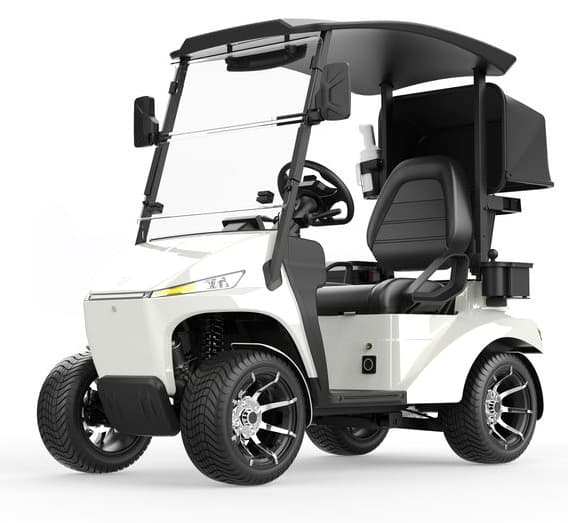
Our DS-02, the everyday single-rider cart in this comparison — see the full gallery, specification and configurator.
We have not reproduced SoloRider's photography here — it is theirs. Their cart is pictured on their own product page, which is also where the figures in the table below come from.
SoloRider 35R vs DS-02, side by side
SoloRider figures as published on solorider.com, August 2026. DS-02 figures from our own factory specification sheet. Blank spots are marked as not published rather than estimated.
| SoloRider 35R | EV Cart Source DS-02 | |
|---|---|---|
| What it is built for | Adaptive golf — players who cannot comfortably stand, walk or swing from a standing position | Everyday single-rider use — a round of golf, plus getting around a resort, campus or private community |
| Seat | Patented electric stand-up seat, 230° swivel, elevates to a hitting position at the touch of a button | Foam-molded heated seat in premium microfiber leather. Fixed — it does not raise you into a swing |
| Controls | Bi-lateral ergonomic hand controls for steering, acceleration and braking. No steering wheel, no foot pedals; operable one-handed | Conventional steering wheel and pedals, with EPS power steering and auto-centering |
| Tires / where it drives | 18×8.5-8 turf-friendly tires, chosen to be gentle on the grass of greens and tees | 12" alloy wheels with DOT-certified 215/35-12 road tires — paths and hard surfaces, not greens |
| Battery | 36-volt battery system | 51.2V 100Ah LiFePO4 (UN38.3, MSDS documented), charges in under 3 hours |
| Cabin technology | Not something we found stated on their product page — ask them | 7" IP66 touchscreen with CarPlay and Android Auto, reversing camera, 5" coaxial hi-fi speaker, one-touch start |
| Price | $17,500 MSRP for the 35R, published on solorider.com (read August 2026) | Not published — we sell wholesale and private-label to dealers, quoted per market, configuration and volume. ⚠️ Not comparable with a US retail MSRP: different currency of sale, different terms, and freight and duty are not in it |
| How you buy it | Their site sells direct; we have not surveyed what other channels they may use | Through a dealer. The platform is built to carry the dealer's own brand |
| Track record | Building single-rider adaptive carts since 1991 | Current-production platform; strongest demand in Europe, growing in North America |
Which one fits which buyer
Choose a SoloRider if…
- The player needs to be raised into a standing hitting position to swing.
- Steering and braking have to work without legs — the hand controls are the point, not a feature.
- The cart must go onto greens and tees, which is what the turf-friendly tires are for.
- A course is buying to meet an accessibility commitment and needs a vehicle designed for that purpose from the ground up.
Look at the DS-02 if…
- The rider can drive an ordinary cart and simply wants their own, at their own pace.
- The cart works a shift — marshals, starters, grounds staff — and a four-seater is more vehicle than the job needs.
- It also has to do everyday runs around a resort, campus or private community, where site rules allow.
- You are a dealer or distributor who wants the cart to carry your own brand rather than someone else's.
What comes as standard on the DS-02
The reason to look at a full-size single-rider cart is that it does not feel like a scaled-down one. These are in the base build, not the options list:
EPS power steering
Bi-directional rack and pinion with auto-centering. Power steering is uncommon on single-seat carts — worth checking against whatever else you are comparing.
Heated seat
Foam-molded cushion in premium microfiber leather, heated as standard.
IP66 7" touchscreen
CarPlay and Android Auto, Bluetooth, radio, plus a high-definition reversing camera.
Lithium, charged in under 3 hours
51.2V 100Ah LiFePO4, UN38.3 and MSDS documented. No lead-acid base model.
The golf accessories, included
Ball washer, onboard cooler, sand bottle and bag cover are in the base build — not upsold.
Built to carry your brand
Embroidered seat logos, custom badge, paint, wheel and key branding and a custom start-up animation.
Full specification, configurator and gallery on the single rider golf cart product page. The battery's UN38.3 and MSDS documentation is available for review, and private-label options are priced into the quote rather than treated as special orders.
If you sell carts rather than buy one
Single-rider is a thin shelf. A floor built around two- and four-seaters often has nothing to show the customer who wants a cart of their own — so that customer either buys a specialist adaptive cart they do not need, or buys nothing. Adding one solo model is a small inventory commitment against a question you are probably already being asked.
We supply wholesale and private-label: how the dealer program works, how ordering and lead times run, and what after-sales looks like. The rest of the range is on the golf cart line-up.
Questions buyers ask
Is the DS-02 a SoloRider alternative?
Only for some buyers. If what you need is the stand-up seat and hand controls — the ability to be raised into a hitting position and to drive without using your legs — the DS-02 does not replace a SoloRider, and we would rather tell you that than sell you the wrong cart. If you want a single-rider cart for ordinary solo play, for course staff, or for getting around a resort or private community, then yes, the DS-02 covers that ground and it carries equipment that a cart built around an adaptive seat has no particular reason to include.
Is a "solo rider golf cart" the same thing as a SoloRider?
Not always, and the difference matters when you search. SoloRider is a brand — a specific adaptive cart, which the company dates to 1991. But solo rider golf cart is also used generically for any one-person cart, the same way people write single rider golf cart or one person golf cart. If you were searching for the brand, their site is the place to go. If you were describing the category, this page compares both kinds so you can tell which one you actually need.
Can the DS-02 drive on greens and tees?
It is not designed for it and we would not recommend it. It runs DOT-certified 215/35-12 road tires on 12-inch alloy wheels, which suit paths and hard surfaces. SoloRider fits 18×8.5-8 tires it describes as turf-friendly and gentle on greens and tees. Whether any cart is actually allowed onto a green is set by the course, not by the tire — but if greens access is your requirement, an adaptive cart on turf tires is the category built for it.
What does a single rider golf cart cost?
SoloRider publishes $17,500 MSRP for the 35R (as of August 2026). We do not publish a retail price, because we sell wholesale and private-label to dealers rather than direct to golfers — the number depends on configuration, volume and destination. A dealer quote usually comes back within one business day.
Why are there so few one person golf carts on the market?
For a long time the category sat at two extremes: adaptive carts built around a specialist seat, and lightweight buggies that fold into a car trunk. Neither was designed as a general-purpose solo vehicle. That is changing — several manufacturers now build full-size single-seaters, ours among them, and if you are shopping the category it is worth looking at more than one of them. What we optimize for is a real golf cart in a single seat — steering wheel and pedals, power steering, a full cockpit — that works for a round of golf and for getting around a controlled site, rather than a buggy stripped down to hit a price.
Is the DS-02 a mobility or medical device?
No, and we do not market it as one. It has no stand-up mechanism, no hand controls and no medical certification. It is a golf and controlled-site vehicle. Buyers who need an adaptive vehicle should talk to a specialist such as SoloRider, or to a mobility dealer who can assess the requirement properly.
Where can a single seat golf cart be driven?
On golf courses, and on private ground where the site's operator allows it — resorts, campuses, private communities and estates all set their own rules on cart access. We make no claim about public-road use; road legality depends on the complete vehicle and on the law where the buyer lives, and that is a question for the buyer's own authority.
SoloRider is a trademark of its owner. EV Cart Source is not affiliated with, endorsed by or sponsored by SoloRider. Competitor details were read from solorider.com in August 2026 and may have changed since; check their site for current specification and pricing.
Bring a single-rider line to your market
Tell us your market, target volume and branding needs — we reply to qualified dealer and distributor inquiries within 1 business day.